
Learning Outcome #4
Professional Standards
Both individually and in teams, you apply a relevant methodological approach used in the professional field to formulate project goals, involve stakeholders, conduct applied research, provide advice, make decisions, and deliver reports. In doing so, you keep in view the relevant ethical, intercultural, and sustainable aspects.
Evidences

(Client Project)
(Client Project)
(Client Project)
(Client Project)
(Client Project)
(Client Project)
(Client Project)
(Passion Project)
(Passion Project)
Group Contract
Introduction
We started by creating a group contract first to define our agreements and communicate with
those expectations we have, that could help improve our overall creative progress. I contributed
to the entire process of completing the document and we individually included our own strengths
and weaknesses as well as the roles and responsibilities we established for each team member.
First Iteration
Before starting our project, we first took the time to get to know each other by discussing our
individual strengths and weaknesses. We also identified our semester goals and what we want
to learn or focus on for this project. This helped us understand how we could collaborate
effectively. We also shared our values for clear communication, metrics of success, and internal
rules that we must all follow. These are outlined in detail in our group contract.
Link: First Group Contract
Second Iteration
After our retrospective, we updated the group contract and came up with a better way to hold
each member accountable for their actions. At first, our group had problems with
communication, but these turned into attendance. To fix this, we implemented a strike system to
ensure everyone follows our rules.
Aside from that, most of us seem to lack proper communication skills, and some lack
organization. So, we also came up with the idea of assigning leaders of departments for
Development, Design, and Research & Documentation. This is implemented so we can improve
our group’s workflow and to have a more focused attention on each area. Each leader guides
and makes final quality decisions to help us progress quickly with our projects.
Link: Final Group Contract
Reflection
Through this, I gathered many realizations and takeaways that I surely will bring for future group
works:
- I’ve learned how each team member approaches projects and I always have to consider those so we all remain in-sync.
- Adding the strike system helped me stay more productive since I made sure to attend meetings and keep the group updated.
- I’ve realized I can help in ways I know, to make sure everyone feels comfortable sharing their ideas since this is what some of our team lack.
In the future, I can improve setting clear expectations from the start, and know each member’s
strengths and weaknesses. This will help not only me, but keep the team on track and make our
meetings more effective.
Scrum Method
Introduction
To guide our creative process and have a healthy working environment with the team, we
decided to use the Scrum method. We’ll manage tasks and track progress on Trello. After each
sprint, we’ll have retrospectives to communicate plans and how we can work as a group.
Trello
With the (Trello) Scrum Board organized by our group, we are able to check our responsibilities,
manage our overall workflow, and get updates on our progress. I use it to check my tasks and
plan my schedule for the project.
Link: https://trello.com/b/Mk6JKvMD/to-do
Retrospective After 1st Sprint
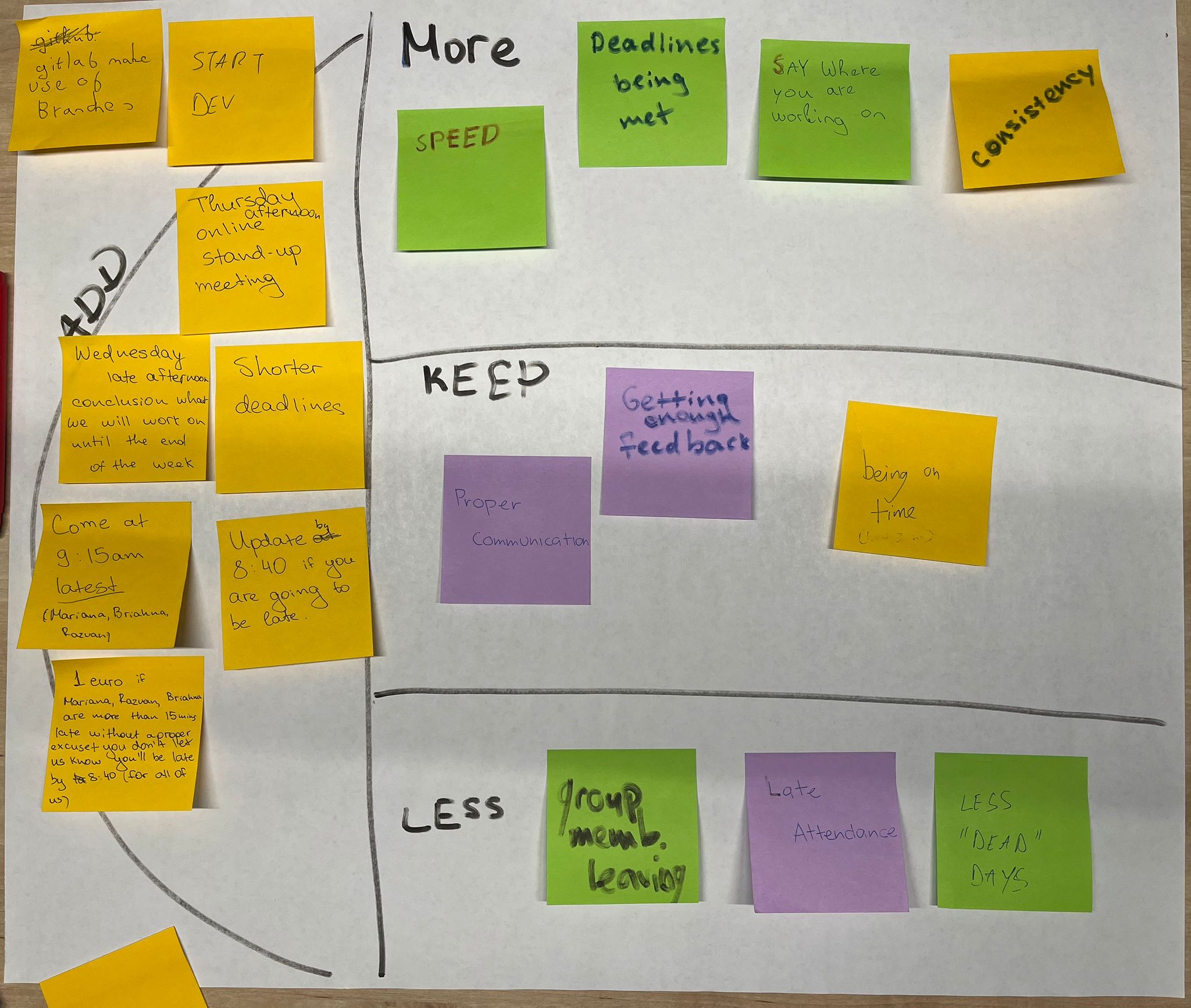
Our group used the KALM approach where everyone gets a sticky note and writes down what
we liked and didn’t like. We then categorized each sticky note into: “More”, “Keep” those we
liked remained, “Less” those we wanted to stop doing, and “Add” solutions to these. Personally,
this gives me insight into my group’s work approach and perspectives. I also believe it will help
me feel more confident in discussing and reflecting on the challenges we’ve faced.
After that, we went through all the sticky notes and discussed the reasons behind what each
person had written. We then expressed our opinions, and came up with solutions to fix issues
under the “Add” category.
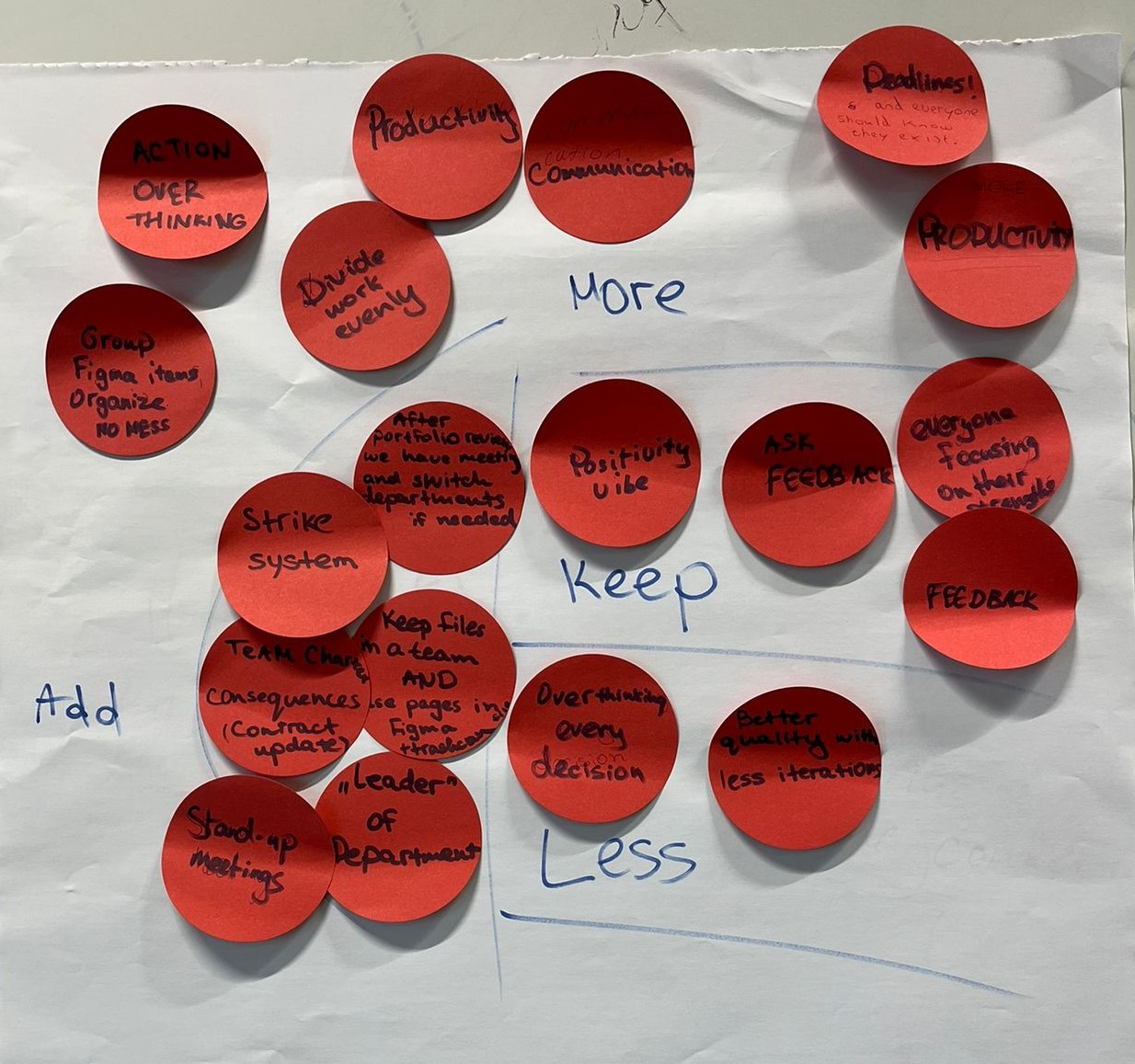
In summary, our general problem is that most of us lack proper communication skills and some
lack organization in work so to solve this we decided to do stand-up meetings every OIL-time at
school.
Retrospective After 2nd Sprint
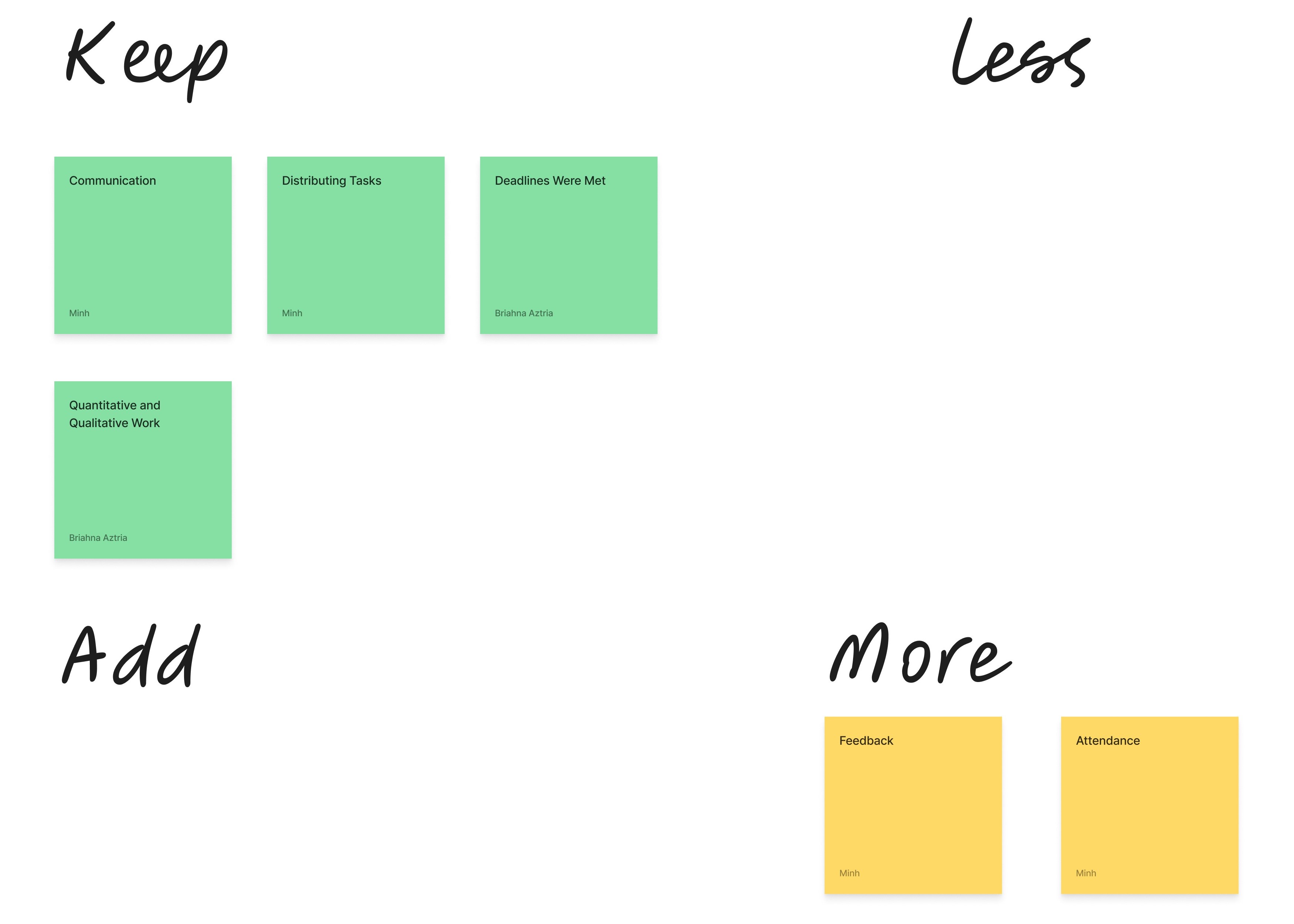
We conducted a retrospective once more with the same approach which is KALM. Instead of
writing down on sticky notes, we used Figma for this process and categorized it again into:
Keep, Less, Add and More.
This time, our work was much better because we divided tasks into subgroups, allowing us to
manage everything more effectively. This approach helped us work more smoothly, meet all
deadlines, and improve the quality of our work.
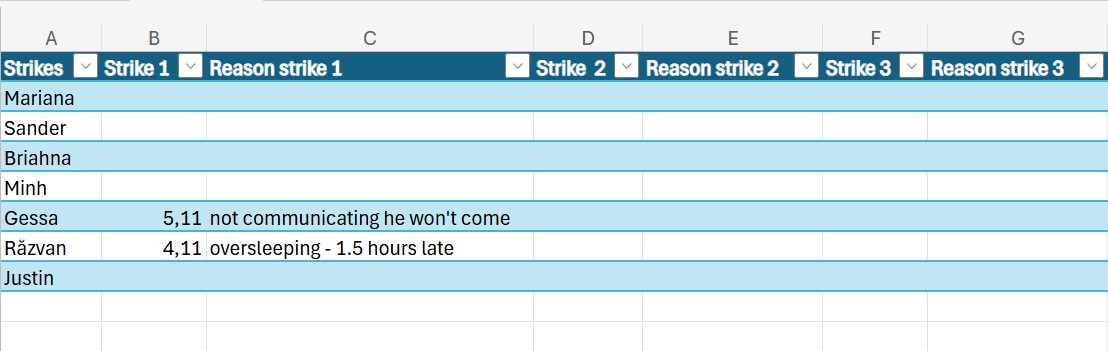
However, we noticed that attendance at our scheduled meetings has been an issue, mostly due
to members being late. In order to collaborate effectively and work as a group, we need to have
complete attendance, but because of these delays, we’re unable to make progress or decisions
together. To address this, we are implementing a strike system to encourage better attendance
and punctuality from all members.
Retrospective After 3rd Sprint
After sprint 3, attendance was still our biggest issue. Since implementing the strike system, we
kept records in our Excel sheet, and one member was constantly not attending classes and not
working from home, so we decided to remove them from the group. Following this, another
member dropped out, reducing our group from 7 members to 5.
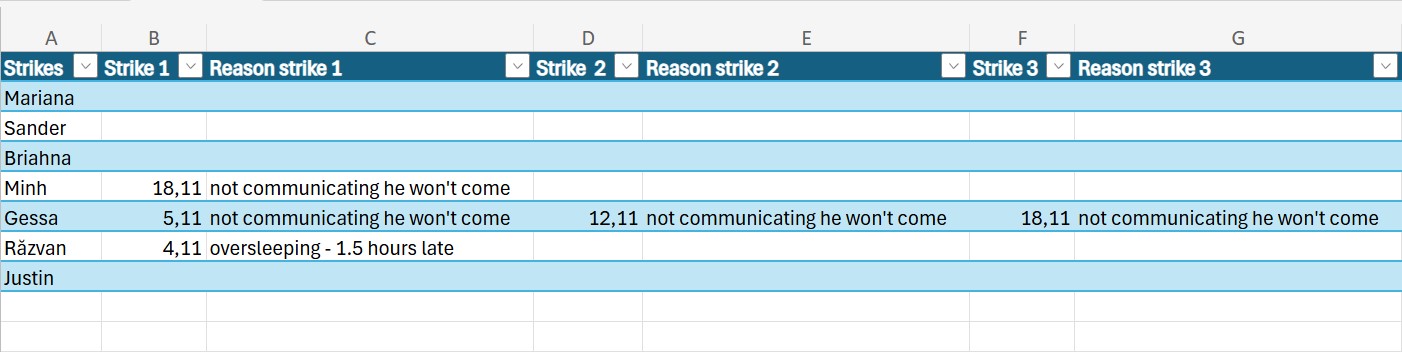
Because of what happened, we have to figure out a different way that will obligate us to attend
and communicate as necessary, since the strike system wasn’t effective enough. We wrote
solutions on sticky notes, then discussed them with the team. We agreed to give money when
we’re late. The money accumulated will be used to buy food as we celebrate the end of our
group project.
Aside from that, we also discussed another problem, which is our ability to meet deadlines on
time, so we all agreed to have online meetings just to be updated with each member’s progress.
Reflection
I learned that once I understand my team’s dynamics, it can help me collaborate well with them,
so with this method, it definitely helped me have a safe space where I can discuss what went
well, went wrong and what solutions we can do. After acknowledging our general problems
through retrospective, we can find solutions to fix these issues to prevent disagreements and
misunderstandings.
Moving forward, I will definitely use this method in all my future projects, as I’ve seen how it
strengthens team communication and encourages continuous improvement.
Client Communication
Introduction
Our team maintained communication with the client to know their preferences. This helps
ensure a better project outcome, client satisfaction and to come up with designs that accurately
represent the target audience.
First Client Meeting
Before we started the project, the team organized a meeting with the client to gather information
and deeply understand their perspective regarding the Fast Fashion project for Night of the
Nerds which will guide our content strategies.
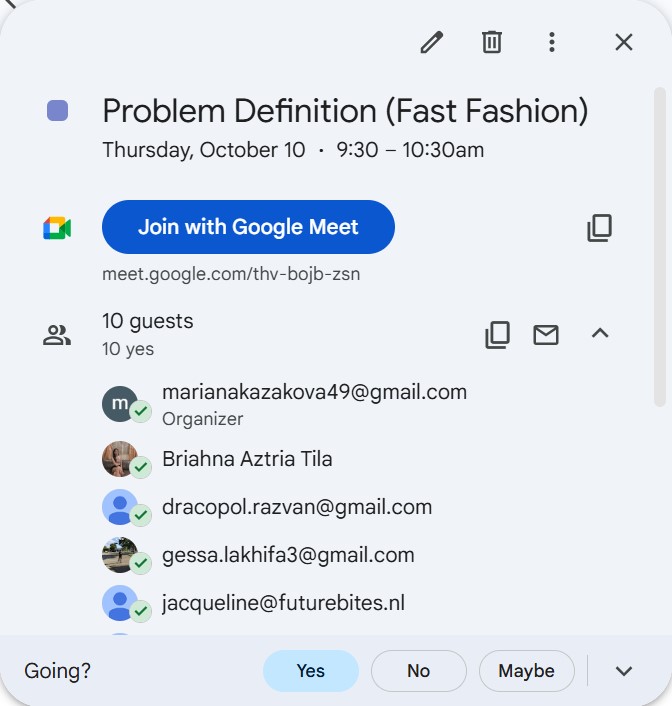
The person who contacted the client through email was our leader. She then set a Google Meet
invite on the agreed time and date with the client. I accepted the invite and made sure to join the
meeting on time.
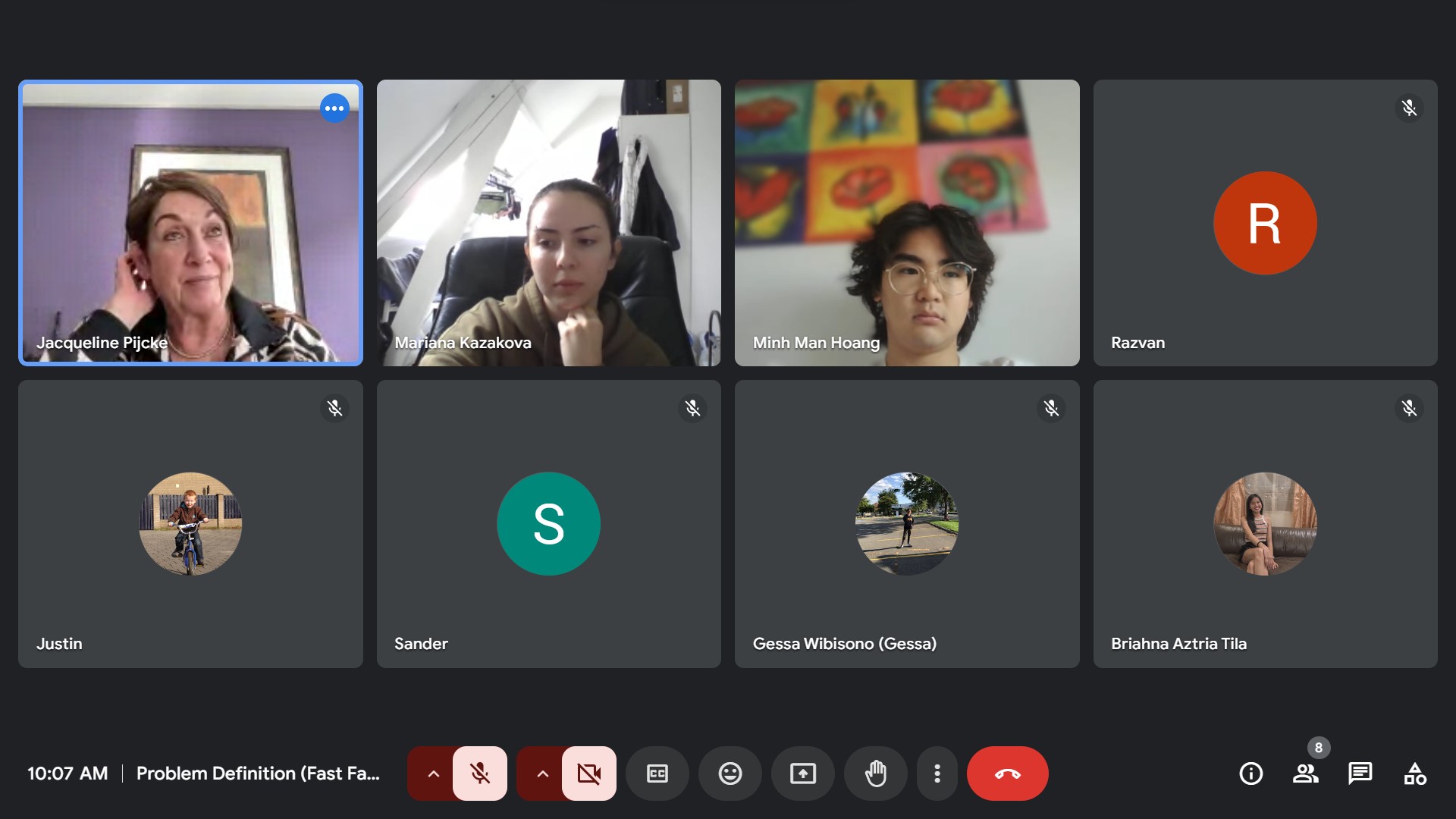
After our group conducted a 40-minute Google Meet interview, Mariana and I proceeded to
make the interview transcript.
Link: Client Interview Transcript (Problem Definition)
Second Client Meeting
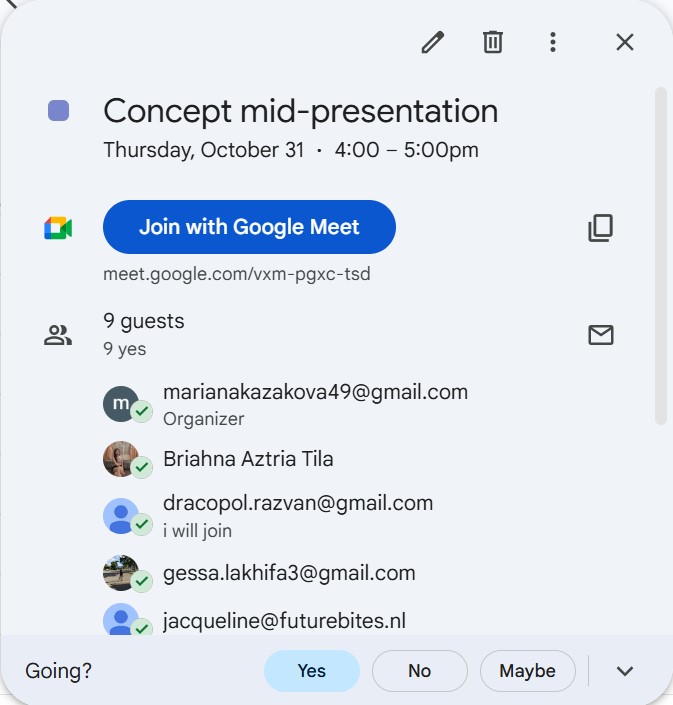
After each of our subgroups conducted research and made designs, we organized a
mid-presentation meeting with the client to share our concepts and to know what the client
prefers as well. The group came together to create a presentation showcasing the concepts
from each subgroup.
Link: Concept Mid-Presentation
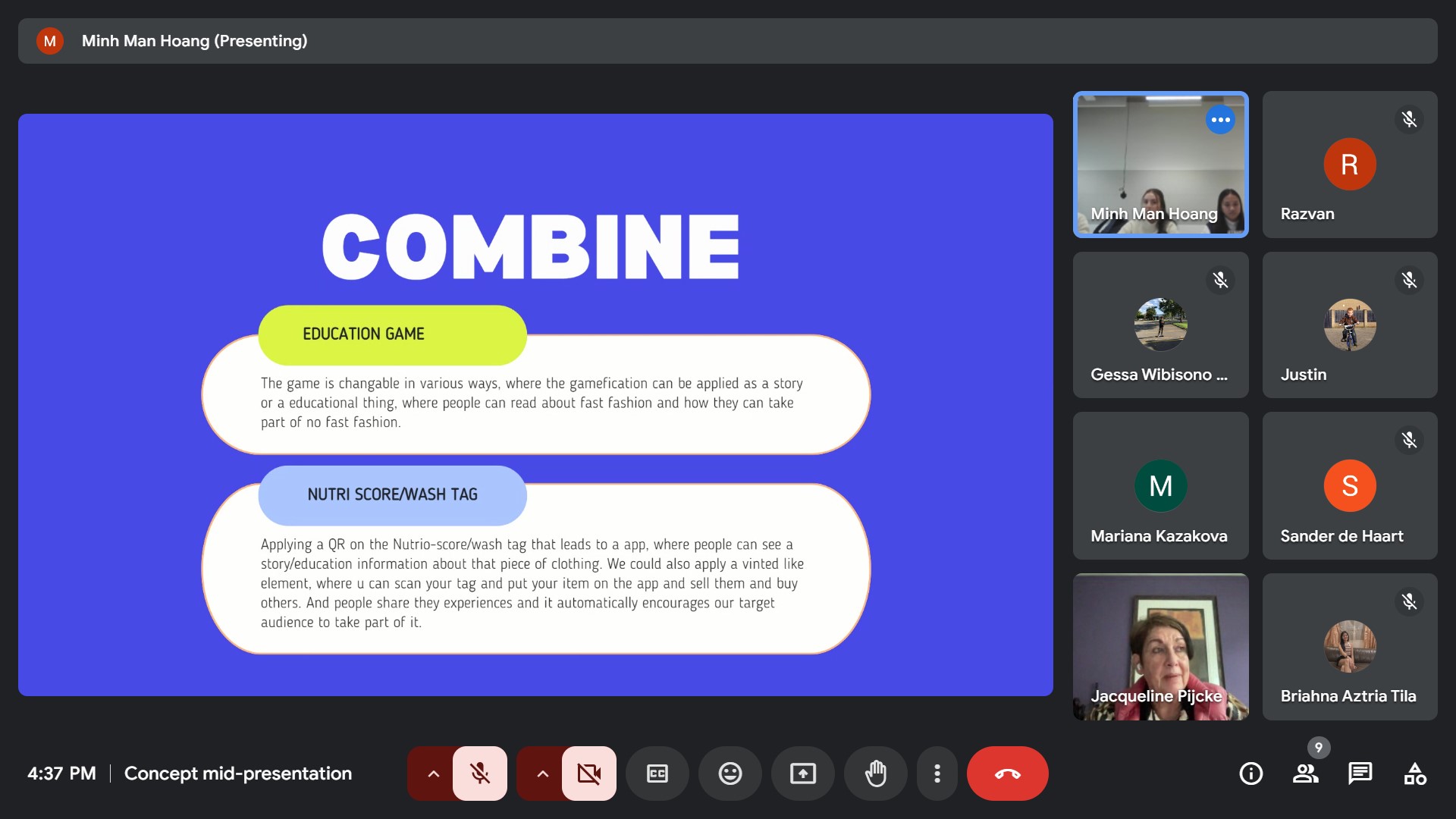
We discussed the goal of our concept which is generally to promote awareness of fast fashion’s
negative impact through games and eco-score labelling for clothes. After the presentation, it
didn’t reach the client’s expectation and was not fully satisfied with our concepts so we
dedicated our time in thinking of different ideas.
Third Client Meeting
After our mid-presentation, the group worked on improving a concept that the client seemed to
like. Then, we immediately organized a meeting with the client, and I put together a presentation
that included our storyline and the MoSCoW table.
Link: Final Concept Presentation
In this meeting, we showed the improved version of the Upcycling with Besties game, where
instead of being a storytelling game like ‘Episodes,’ the game is now more similar to a typical
surgery game, where the player really has to choose from workshop tools.
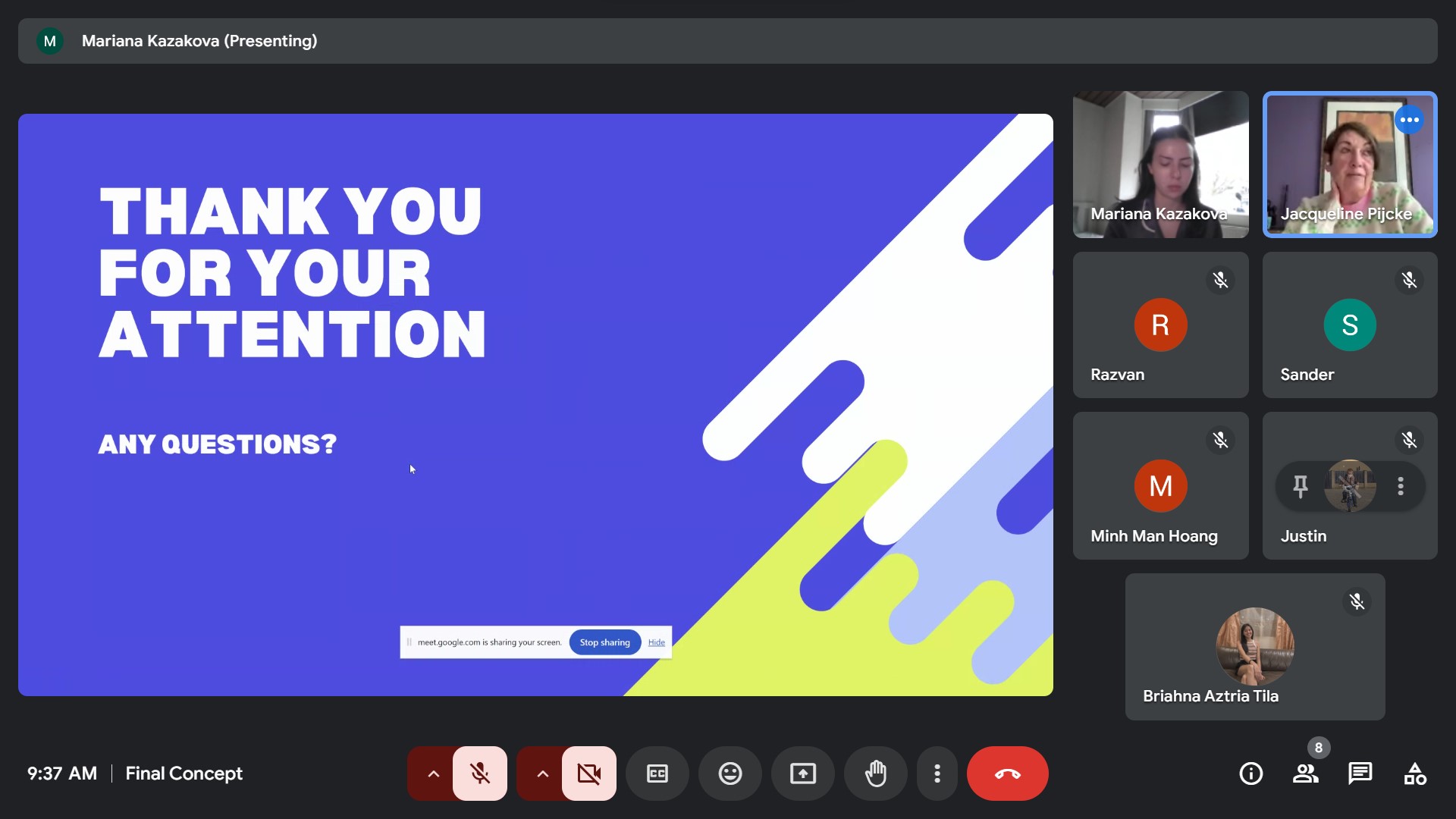
We finally reached our client’s expectations and liked the concept we presented. After we ended
the meeting with our client, I made a transcript of it that will guide us in finishing the game.
Link: Client Presentation Transcript (Final Concept)
Fourth Client Meeting
Our group decided to organize a meeting with the client again so they’ll be updated on our
progress and to actually see the concepts come to life. During the meeting, I presented the
prototype I created and demonstrated the gameplay of the upcycling game, while also
explaining the concept behind it.
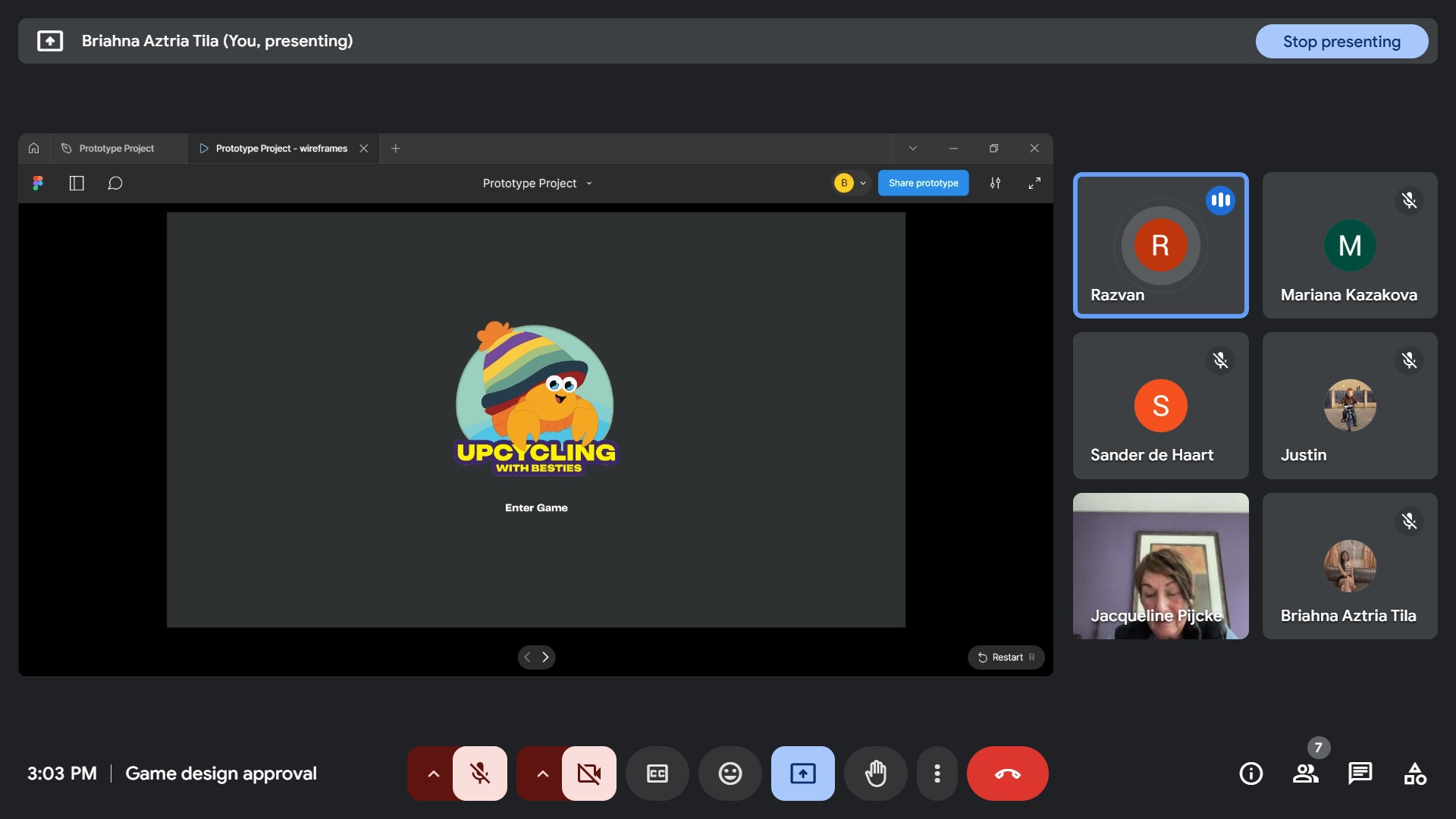
The client liked the game and just mentioned a few suggestions:
- See the characters wearing the clothes they upcycled.
- A voiceover for Lisa.
- A short introduction (trailer) that explains the game for at least 30 secs.
- Add credits at the end of the game.
Reflection
I learned the importance of knowing the client’s perspective, as it can guide my creative process
and help me ensure that I truly capture the target audience’s preferences. I will definitely
prioritize regular communication with clients in my future projects to keep them updated on the
project’s progress and maintain alignment with the client’s vision.
Brainstorming
Introduction
To start our project, we needed a clear way to generate ideas and organize our thoughts so I
suggested and led the brainstorming session for our group, where we came together to share
our ideas. We decided to use two techniques: Brainwriting and Lotus Blossom.
Brainwriting
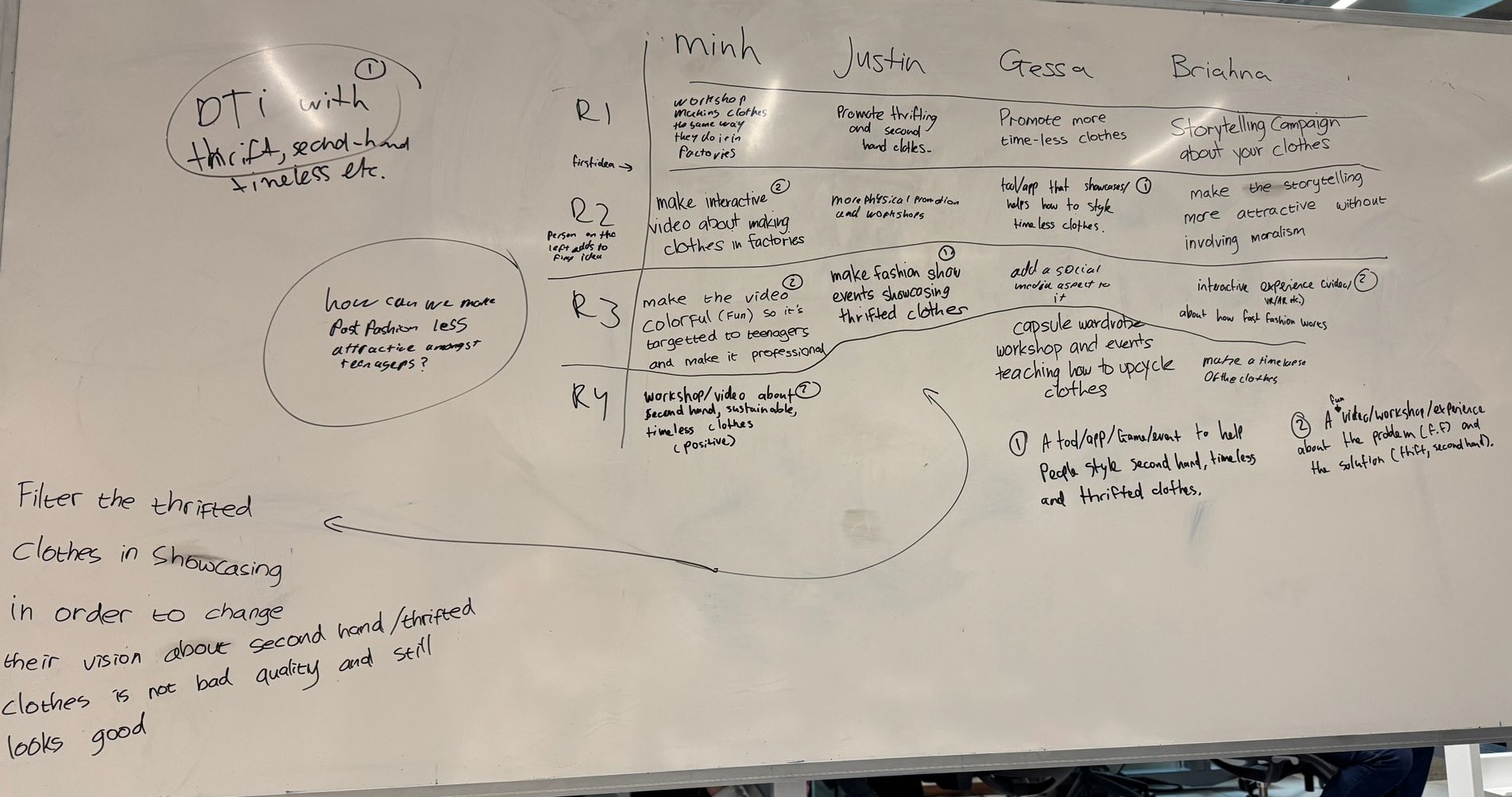
Together with 3 other members who were present that day, we first conducted brainwriting which
involves discussing ideas to create the best solution. This helped members of the group to think
creatively and share ideas. We answer the question: “How can we have fast fashion be less
attractive amongst users?”.
Process
Everyone wrote down their thoughts and then shared them with the group. I wrote my ideas as
well. Then, everyone moves one row to the right and generates an idea based on what’s above
the current row. We continued to exchange ideas and build on them for a few rounds.
Insights
So from our brainwriting, we gathered: seek workshops, encourage youth to purchase from
second hand/thrift stores, promote timeless clothes and storytelling. This method was really
helpful for expanding on each other’s ideas, and I would definitely suggest using it for future
projects.
Lotus Blossom
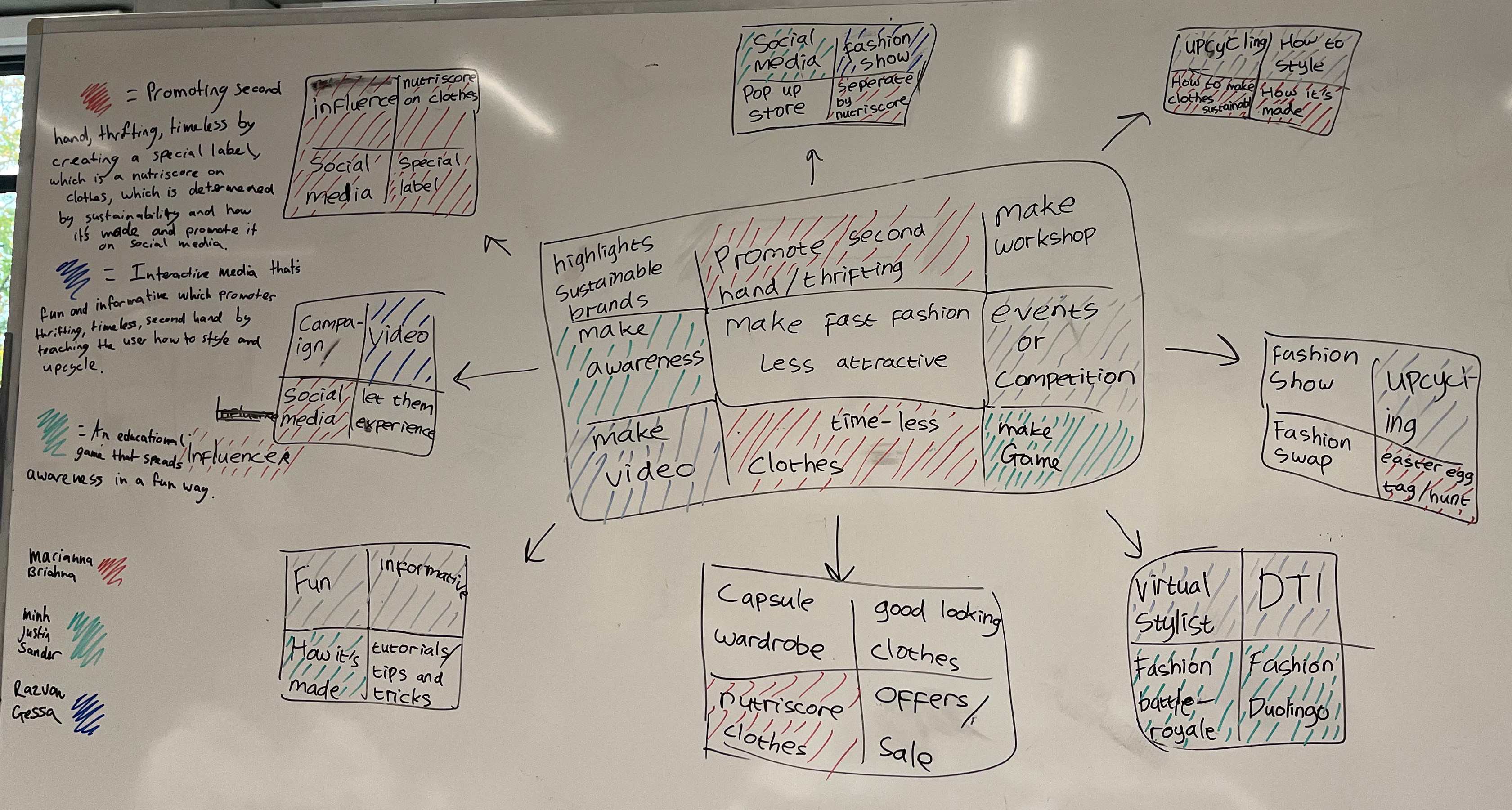
After the brainwriting, we then proceed to lotus blossom with all members present. This method
helped us break the problem down and look at it from different perspectives at the same time, it
allowed us to have a more detailed discussion of what we can do to reach our goal: making fast
fashion less attractive.
Process
So we proceed by placing the main goal we have in the center of the group and we write down
thoughts. I wrote my ideas and expanded on them. We generated 8 ideas, we then generated 4
more ideas for every one of the 8 initial ideas and connected its features. We divided it into 3
aspects: usability, technology, engagement then categorized between groups and finally worked
out the concept.
Insights
From our lotus blossom, we came up with our final concepts, and here is what we decided:
- Promoting sustainable clothing by creating a special label, an “Eco-Score” for clothes, which is determined by sustainability and how it’s made.
- Interactive media that’s fun and informative, promoting thrifting, timeless pieces, and second-hand clothing by teaching users how to style and upcycle.
- An educational game that spreads awareness in a fun way.
This method helps in focusing on important points and allows us to slowly build the concept with
input from everyone, which makes the process more effective.
Primary Research
Introduction
I conducted primary research through interviews with our target audience, teenagers aged
15-17, with a goal of understanding their awareness of the negative impacts of the fast fashion
process. We created questions to ask them about their reasons why they buy from such stores,
as well as the problems they have encountered. The findings gathered from this will help
address, “What is the percentage of thrifted clothes vs fast fashion clothes in a wardrobe
amongst teenagers?” and from there we can create a product to encourage them into
sustainable fashion practices.
Method
I used Field research in the form of Interviews, where we came up with questions, went to the
location of choice, and engaged with our target audience. We asked them specific questions to
gain insights into their preferences and properly reported the findings.
Process
After we received a go signal from our teacher, Mariana and I went to the city center specifically
to fast fashion and second hand stores to conduct our interview. We gathered 4 interviews only
from fast fashion stores. We didn’t see anyone in the age range (15-17 y.o) at the second hand
stores so we weren’t able to conduct an interview there. But to prevent any form of biases, we
asked the interviewees to close their eyes and let them touch two pieces of clothing—one from
Zara and one from a second hand store.
The attached compilation of our interview transcripts below will help to shape a product or
service catered to this demographic. I can develop solutions or concepts that prioritize
affordability, style, and convenience while addressing ethical and practical concerns.
Link: Interview Transcripts
Findings
The findings from the interviews help address one of our research questions: ‘What is the
percentage of thrifted clothes vs fast fashion clothes in a wardrobe amongst teenagers?’ The
answer is that participants mostly have fast fashion clothes in their wardrobes, with very few
thrifted items. Most of the target audience prefers shopping at fast fashion stores but is unaware
of how the clothes are produced. Part of it also is that there are less thrift store choices in the
area. They expressed guilt about that and considered their clothing choices in the future.
From these answers we gathered, I plan to brainstorm ideas I have in mind but focus on
creating a product that can be: functional, easy to use/navigate and creative to raise awareness
and encourage sustainable fashion practices among our target audience.
Secondary Research
Introduction
From the primary research, we were able to understand the perspectives of young consumers
(15-17 y.o) regarding their awareness of fast fashion’s negative impacts. After that, Mariana and
I came up with different questions for our secondary research and split them up. Here are the
questions I focused on:
- What is an Eco-Score, and how does it differ from other scoring systems like the Nutri-Score?
- How is the Eco-Score calculated, and what factors contribute to its final grade?
- What does each part of the Eco-Score represent in terms of sustainability and ethical standards? standards?
- Why is the Eco-Score important for promoting sustainability within the fashion industry?
From these questions, I derived the main research question: “What is an Eco-Score, and why is
it needed?” The answers from these questions aim to promote the significance of Eco-Score
which is a simple A-to-E rating system to assist the teenagers in making eco-friendly choices
when purchasing clothing.
Method
To guide the secondary research, I used Library research, specifically Literature Study that will
help thoroughly explore Eco-Score’s potential. I reviewed articles, and papers related to
sustainable fashion and summarized those findings in a research paper.
Link: Eco-Score Research
Findings
The question, “What is an Eco-Score, why is it needed?” was addressed by the literature study I
conducted. The answers show that clothing stores have different ways of product-making that
could either help or destroy the environment, and as consumers, we don’t know much about
that. To lessen the effects of fast fashion, we introduced the Eco-Score — a guide to young
consumers towards responsible shopping. It also promotes awareness and provides an easy
understanding of what is a better option through a simple A-to-E rating.
In conclusion, the Eco-Score labeling should be encouraged for use in clothing stores to help
consumers make more informed and eco-friendly choices, especially since tools to assess
which products follow sustainable practices are still lacking nowadays.
After this secondary research, these findings helped strengthen our concept of the Eco-Score.
Based on this, we created visuals for Eco-Score Label, to show how using it could be beneficial
in making ethical shopping choices clearer and easy to understand especially for young
consumers.
Game Usability Testing
Introduction
My groupmates and I tested the usability of our game Upcycling with Besties for both the initial
prototype and the final product. This game is all about teaching how to upcycle old items mostly
targeted on the young consumers (15-24 years old) that’s based on the research and survey we
conducted before proceeding to step. We conducted our first usability test on the initial
prototype created in Figma, and another usability test on the final product, which was the
version we coded. My primary role in this testing is to document the feedback we’ll receive. This
feedback is important for improvements and polishing of the game before completion.
Initial Prototype
The purpose of this usability test is to evaluate the intuitiveness of the game prototype’s
navigation, mechanics, in-game instructions, and design, as well as to gather insights on user
satisfaction and overall experience. The goal was to answer the following questions:
- How do users interact with the game based on its design and interface?
- Are the instructions clear and helpful in guiding users through the game?
- Do the designs make it easier for users to engage with the game and follow instructions?
- Do users fully understand the game flow and know what to do next?
Method
Mariana and I conducted the first usability test and invited 5 users to test our game. Most of the
participants were students within our age range (15-24 years old), and one participant was a
teacher. My primary role in this testing is documenting the feedback and main observations of
the users. This is important for drafting the usability testing results and the list of improvements
for the game.
Link: Initial Prototype Usability Report
Findings
- Navigation and Interaction: Users struggled with drag-and-drop mechanics and screen navigation, expecting more uniformity and accessibility.
- Visuals: Praised for appealing design but suggested improvements like enhanced characters and new tasks.
- Functionality: Functional flow, but clearer instructions and an introductory guide are needed for better understanding.
Insights
Overall, the usability testing revealed the issues that users experienced in terms of navigation
and interaction in the game, such as the drag-and-drop feature and onboarding flow. We also
found that users find the game appealing due to the style, theme, and uniformity of the
elements, which also made the game more functional.
Final Product
The purpose of this usability test is to evaluate the functionality, navigation, and design of the
final game, ensuring that revisions have improved the user experience and satisfaction. The
goal was to answer the following questions:
- How do users feel about the overall game experience, considering the design, theme, and details?
- What are the main issues or frustrations users face while playing?
- Do the design and features improve the functionality and onboarding process for users?
- Do users experience a smooth game flow with clear instructions?
Method
Together with my two group members, we conducted the second usability test and invited 4
users within our target age range (15-24 years old) to test our final game. My primary role in this
testing was documenting the feedback and our main observations of the users. This is important
for understanding the overall experience and effectiveness of the game we have created.
Link: Final Product Usability Report
Findings
- Navigation and Interaction: Users suggest adding an introduction to explain what the game is about to improve navigation.
- Visuals: The game is visually appealing, but users suggest making the chatbox smaller and adding tool designs to better fit the game.
- Functionality: Users suggest improving the drag-and-drop functionality so that dragging the item works even when it’s outside the circle.
Insights
From the usability testing, users were able to share their positive feedback on the game’s
design, details, and concept, which boosted its overall interactivity. But improvements remain in
game navigation, game interaction such as dragging, and the design of some game details,
such as the chatbox.
Advice Report
Introduction
The group created this advice report, which includes both the current status of the game and
future recommendations, along with an analysis of the associated risks. It is designed to support
decision-making and guide long-term planning for our game.
Process
Together with 2 of my groupmates, we created the advice report for our client right after we
accomplished the final product/version of the game. First, I organized the structure based on the
template document sent to us. Then the 3 of us worked on one document to input information.
Aside from doing the structure, I specifically worked on the following: I contributed to the
abstract which we did altogether. I wrote the information for methodology. We discussed future
recommendations that we won’t be able to add right now, so I contributed these ideas to be
included in the specific recommendations. I then helped with the content for action steps of our
advice report.
Link: Advice Report
Final Client Presentation
Introduction
We have the opportunity to present the final version of our game, Upcycling with Besties, that
teaches how to properly upcycle items. The final game is shown along with all its deliverables,
to Jacqueline, the key stakeholders for Night of the Nerds. This presentation showcases the
results of our hard work and creative effort, where we will highlight how the game meets the
objectives of promoting sustainable fashion in an engaging, interactive way for young
audiences.
Process
Our group then focused on the presentation of our upcycling game, and we agreed on
discussing the target group, our design process, the game demo and some future plans for the
game. After completing our presentation, we asked for feedback from our teacher, Stan, to
ensure its effectiveness in engaging the audience. He advised us to make it into a storytelling to
make it more interesting and memorable for the audience.
Link: Final Client Presentation
On December 12th, 2024, we presented our upcycling game in front of our client, teachers, and
some students. I was responsible for presenting our target group and the design process for the
game. I made sure to include the storytelling approach our teacher advised, particularly when
discussing the design process. We then received valuable feedback that will help the game’s
user experience moving forward.
Reflection
From 7 members to now 4, each member stepped up, taking on extra responsibilities and
showing adaptability under pressure. The presentation went well and I feel relieved that we
delivered it smoothly. It left me with a deep sense of accomplishment and important lessons for
the future. It reflected not just our hard work, but also the creativity and dedication that each
member brought to the project.
Stakeholder Interview
Introduction
In Europe, our family friend owns a van services business that offers travel experiences to
Filipino tourists. To support their growth and also improve my website development skills, I
initiated this project with the goal of increasing their online visibility in the competitive van tours
industry based in Rome. With that, I conducted a stakeholder interview with Patrick Manalad,
the owner and key contact, to know their goals and audience. This interview serves as the
foundation for the website development project.
Method
I conducted a Field Research through an interview, where I asked questions like the business
origin, the target customers, layout and structure of different sections they prefer. After this, I set
an online meeting with the stakeholder (since he’s based in Rome) then proceed with asking
him the questions I prepared. The meeting went well and I was able to collect the needed
details. I typed the transcript of the overall interview which you can click here:
Link: Stakeholder Interview Transcript (Problem Definition)
Problem Statement
From the interview, I gained a clear understanding of the problem, which is that the business
currently lacks a centralized online presence and requires a straightforward, easy-to-navigate
website to effectively reach potential customers searching for Filipino drivers in Europe.
Interview Findings
The findings from the interview show that:
Business Origin
The primary target audience consists of Filipino tourists, with a focus on airport/van tours in
major European cities. The business faces competition from other Filipino van services which
are Mega VIP Transport, BCN Montjuic Tourist Point and Rice Van Rental Europe in this region
so I plan to conduct research on these competitors to gain a deeper understanding about the
competitive side of the industry.
Desired Features
Patrick prefers a simple website with a Home page, Review section, Gallery and a basic
Booking form for inquiries. He also mentioned that he wants as few pages as possible but
informative, he doesn’t need client login or driver tracking map since inquiry form serves the
purpose.
After knowing that the business lacks online visibility, I will make a website that is
easy-to-navigate and designed to attract customers. These findings will contribute in
determining the number of pages, layout and the stakeholder’s preferences, including Home
Page, Review section, Galley and a basic Booking form that I will add once I proceed with
website prototyping. I would like to highlight destinations, comfort and safety, specifically for
Filipino tourists as they’re searching for Filipino drivers in Europe.
Competitor Research
Introduction
After conducting the stakeholder interview and receiving the list of competitors for Filipino Driver
Europe, I conducted competitor research on companies like Mega VIP Transport, BCN Montjuic
Tourist Point, and Rise Van Rentals. The goal was to evaluate their website design, services,
and user experience. The main question to be answered is “How do competitors’ websites
enhance their van services and tours?” To answer this, I focused on the following key questions:
- What van services and tours do they offer, and how are they presented on their website?
- Is their website easy to navigate and optimized for mobile use?
- Do they provide an online booking system or inquiry form, and how user-friendly is it?
- What are the unique features or content on these websites, and how do they help showcase their services?
This research aims to identify best practices and improvement opportunities in the design and
functionality of websites in the van services and tours industry. It will guide the development of
Filipino Driver Europe’s website by enhancing its design, improving usability, and ensuring it
meets industry standards to better attract and serve customers.
Method
To guide my secondary research, I used library research, specifically competitive analysis, to
explore the potential of van services and the tour industry. I reviewed relevant articles and
studies and summarized the findings in a research paper.
For this project, I analyzed each competitor’s website by comparing their offerings. I focused on
aspects like how services were presented, website navigation, and the user-friendliness of their
booking or inquiry form to answer the research questions.
Link: Competitor Research
Findings
The question, “How do competitors’ websites enhance their van services and tours?” was
addressed by the competitive analysis I conducted. Filipino-owned services like Mega VIP
Transport, BCN Montjuic, and Rise Van Rentals effectively present their strategies.
- In terms of mobile optimization, Mega VIP Transport benefitted from having this as they offer a user-friendly and readable layout. Aside from that, Mega VIP stands out with a simple online booking form. These advantages enhance their van services since not only they’re straightforward which appeals to the customers, but you can also contact them immediately.
- Even though BCN Montjuic has their own share of struggles with optimization, they approach this industry’s customers by focusing on visuals and images to enhance their website’s van tours promotion. What makes them stand out is that clicking on each image leads to more detailed information. BCN Montjuic even has a Gallery section showcasing big personalities who availed their services. They’re able to attract the tourist’s attention and trust with this strategy so I’d surely apply this on the website’s prototype.
- Rise Van Rentals provides a straightforward and quick overview without the need to navigate through multiple pages which can be a very comfortable experience for the customer browsing through their website. Aside from that, Rise Van Rentals gives a step-by-step process which is very user-friendly and less hassle.
From these findings, I was able to grasp what strategies I can do after answering the main
question, “How do competitors’ websites enhance their van services and tours?”. More
companies should focus on having a well-designed website with easy navigation, mobile
optimization and integrated booking systems to enhance the van services promotion of which I
will aim to achieve as I proceed with prototyping for Patrick’s small van tours business. Having
not only an updated website but one that features their best offerings, helps build trust and
loyalty especially in this industry with a lot of known competitors.